THE MOMENT YOU'RE IN
You have done real work to get here. You found the story, you drafted it, you steadied it — and perhaps a developmental review has already told you the structure holds. The bones are sound.
And yet.
Strong passages sit beside weaker ones. A scene carries the weight the story needs and still feels flat on the page. You tighten a sentence, and the paragraph around it does not move. You go back in to fix one thing and find yourself fixing everything at once, until you are no longer sure what the manuscript actually needs.
This is not a failure of effort, or skill, or care. It is what happens when revision becomes reactive — when there is no order to the work.
The manuscript stands. It does not yet breathe.
WHAT REFINEMENT ACTUALLY IS
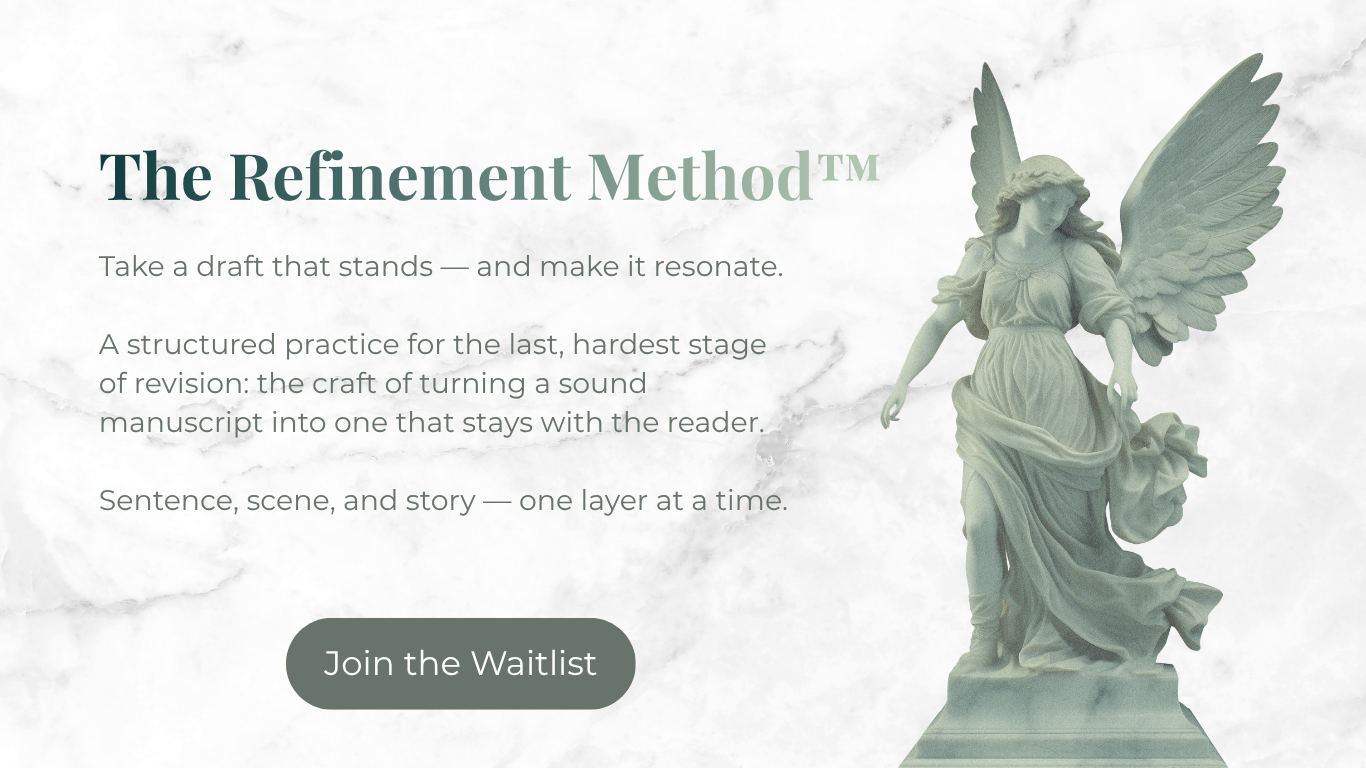
"I saw the angel in the marble and carved until I set him free." — Michelangelo
Refinement is not decoration, and it is not fixing. It is a disciplined way of seeing what is already there.
A sculptor does not add marble. She studies the form beginning to emerge and removes what obscures it — first for balance, then for shape, and only at the end for expression. The order is the whole art.
The same is true of a manuscript. By the time refinement begins, the page is no longer blank. Something has already taken shape, even if that shape is still half-hidden. Refinement is the work of recognizing that form and strengthening it, in the right order, one layer at a time.
Which means it begins not with fixing, but with listening. Before you change a single line, you learn to hear where the writing is unclear, where it goes slack, where it rushes past its own best moment. You listen first.
Then you refine.